Bachelor of Architecture
Rhett Russo, Associate Professor
Chair
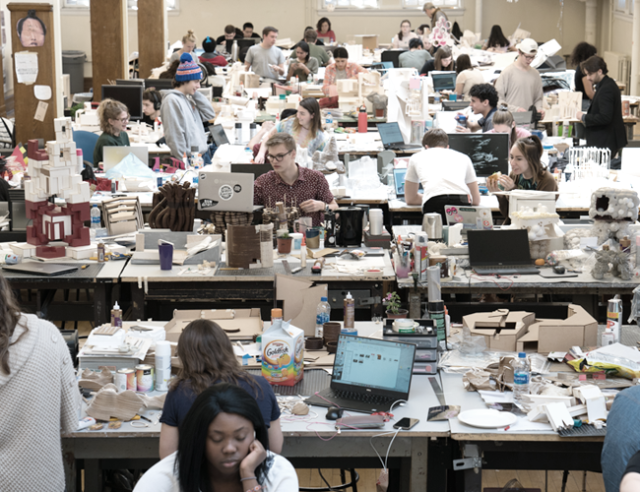 First Year Design Studio
The five-year undergraduate professional degree program seeks applicants curious about the acquisition of knowledge, the creative and scientific aspects of buildings, the importance of ecological design, the power of learning, the value of hard work, and the transformative opportunities afforded the next generation of architects committed to changing the world. Conceived as a supportive and inspiring environment for the beginning student of architecture, the program offers a comprehensive curriculum comprised of architectural design, history/theory, and technology courses as preparation for our graduates to become future leaders in the profession.
The School has an extensive international study abroad program enabling students to spend one full semester in Italy, Latin America, India, or Asia. In addition, the School also offers a semester-long program in New York City for undergraduate students to study at the Center for Architecture Science and Ecology (CASE) as an opportunity to pursue research on next-generation sustainable architecture.
The Bachelor of Architecture from Rensselaer is a professional degree fully accredited by the National Architectural Accreditation Board. Graduates of the School are distinguished by being creatively independent, technologically astute, progressive, professionally ambitious with a strong sense of social responsibility, and prepared for career advancement at any level.
Contact: David Bell, Associate Professor
Acting Associate Dean
518-276-6862
 Malika Yansaneh (BArch ’22)
The five-year B.Arch. program concludes with a year-long individually developed and comprehensive final project in the context of optional research studio and thematic contexts provided by faculty. The first semester of the final project integrates a Research Methods seminar. An integrated design research phase continues throughout the first and the second semesters.The final project is an opportunity to develop a point of view about architecture and its place in the world; to question conventions, habitual responses, and routine approaches to architectural design; and to investigate issues that the student sees as significant to architecture.
The ARCH program is mandatory for all RPI undergraduates who enter in the fall 2017 and afterward. B ARCH students must fulfill the All-Institute AWAY requirement in the summer after their 2nd, 3rd, or 4th year.
A sample template of the B.Arch. curriculum structure is provided below. Please note that special circumstances such as participating in a semester abroad or a semester at CASE in New York City may involve some variation from this template.
The Bachelor of Architecture degree requires 172 credit hours.
All undergraduate students should develop a Plan of Study with their faculty adviser.
Program Curriculum
First Year
Fall
| Course Number | Course | Credits |
| ARCH-2150 | The Ethos of Architecture | 3 |
| ARCH-2160 | Architectural Media | 2 |
| ARCH-2510 | Materials and Design | 2 |
| ARCH-2520 | Digital Constructs 1 | 2 |
| ARCH-2800 | Architectural Design Studio 1 | 5 |
| MATH-1500 | Calculus | 4 |
|
|
Semester Total: | 18 |
| Program Running Total: | 18 |
Spring
| Course Number | Course | Credits |
| HASS | HASS Inquiry and Communication Course | 4 |
| ARCH-2370 | Energy, Comfort and Ecology | 2 |
| ARCH-2530 | Digital Constructs 2 | 2 |
| ARCH-2810 | Architectural Design Studio 2 | 5 |
| ARCH-4090 | Architectural Case Studies | 2 |
| ARCH-4100 | An Architectural Genealogy | 3 |
|
|
Semester Total: | 18 |
| Program Running Total: | 36 |
Second Year
Fall
| Course Number | Course | Credits |
| ARCH-2330 | Structures 1 | 3 |
| ARCH-2350 | Construction Systems | 2 |
| ARCH-2540 | Digital Constructs 3 | 2 |
| ARCH-2820 | Architectural Design Studio 3 | 5 |
| ARCH-4050 | Cities & Their Territories | 2 |
| ARCH-4120 | Modernity & Architecture | 3 |
|
|
TOTAL: | 17 |
| Program Running Total: | 53 |
Spring
| Course Number | Course | Credits |
| ARCH-2360 | Environmental and Ecological Systems | 4 |
| ARCH-2550 | Digital Constructs 4 | 2 |
| ARCH-2830 | Architectural Design Studio 4 | 5 |
| ARCH-4150 | Contemporary Design Approaches | 3 |
| PHYS-1050 | General Physics | 4 |
|
|
TOTAL: | 18 |
| Program Running Total: | 71 |
Third Year
Fall
| Course Number | Course | Credits |
| HASS | HASS Elective | 4 |
| SCIENCE | Science Elective | 4 |
| ARCH-43301 | Structures 21 | 3 |
| ARCH-4770 | Architectural Design Studio 5 | 5 |
| ARCH-45901 | Entrepreneurship & Architecture1 | 2 |
| ARCH-42001 | Portfolio Development1 | 1 |
|
|
TOTAL: | 19 |
| Program Running Total: | 90 |
1Note: These courses are also taught in spring of 3rd year
Spring
| Course Number | Course | Credits |
| MATH | Math Elective | 4 |
| ARCH | Professional Elective | 2 |
| ARCH | Professional Elective | 2 |
| HASS | HASS Elective | 4 |
| ARCH-4780 | Architectural Design Studio 6 | 5 |
|
|
TOTAL: | 17 |
| Program Running Total: | 107 |
Fourth Year
Fall
| Course Number | Course | Credits |
| ARCH-48202,3 | Comprehensive Design Studio 12,3 | 5 |
| ARCH-43202,3 | Building Integration 1 – Design2,3 | 3 |
| ARCH-45403 | Professional Practice 13 | 2 |
| ELECTIVE | Free Elective | 4 |
| HASS | HASS Elective | 4 |
|
|
TOTAL: | 18 |
| Program Running Total: | 125 |
Spring
| Course Number | Course | Credits |
| ARCH-48302,3 | Comprehensive Design Studio 22,3 | 5 |
| ARCH-4550 | Professional Practice 2 | 2 |
| ARCH-43252,3 | Building Integration 2 – Practice2,3 | 3 |
| ARCH | Professional Elective | 2 |
| SCIENCE | Science Elective | 4 |
|
|
TOTAL: | 16 |
| Program Running Total: | 141 |
Fifth Year
Fall
| Course Number | Course | Credits |
| ARCH | Professional Elective | 2 |
| HAAS | HASS Elective | 4 |
| ELECTIVE | Free Elective | 4 |
| ARCH-4790 | Architectural Design Studio 7 | 5 |
| ARCH-4910 | Final Project Design Research Seminar | 3 |
|
|
TOTAL: | 18 |
| Program Running Total: | 159 |
Spring
| Course Number | Course | Credits |
| ARCH | Professional Elective | 2 |
| ARCH | Professional Elective | 2 |
| ELECTIVE | Free Elective | 4 |
| ARCH-49204 | Final Project Design Studio4 | 5 |
|
|
TOTAL: | 13 |
| Program Running Total: | 172 |
| General Note: | As part of the continual improvement of the B. Arch curriculum, the SoA is substituting two courses in the technology sequence:
OLD SEQUENCE (6 cu): ARCH 4740 (4 credits) ARCH 4560 (2 credits) NEW SEQUENCE (6 cu): ARCH 4320 (3 credits) / Corequisite with ARCH 4820 ARCH 4325 (3 credits) / Corequisite with ARCH 4830 |
2Please Note the Following:
| 2022 COHORT | 2nd-year students during Spring 24: In Spring 2025 ARCH 4740 (4 credits) and ARCH 4560 (2 credits) = 6 total credits, will be substituted with ARCH 4320 (3 credits) in 4th year with ARCH 4820 and ARCH 4325 (3 credits) in 4th year with ARCH 4830. This cohort will not be required to take ARCH 4740 or ARCH 4560. Degree works will be updated to reflect this change |
| 2021 COHORT | 3rd-year students during Spring 24: a. A student that has completed ARCH 4740 (4 cu):
b. A student that has completed ARCH 4560 (2 cu)
|
| 2020 COHORT | 4th-year students during Spring 24: If you have completed ARCH 4820 and are taking, or have completed ARCH 4830 in Spring 24 and you: a. A student that has completed:
b. A student that has completed ARCH 4740 (4 cu):
c. A student that has completed ARCH 4560 (2 cu):
|
3Please Note the Following:
| 4th year co-requisites | a. the fall semester of the 4th year ARCH-4820 CD1, ARCH-4320 B1-1, and ARCH-4540 PP1, are co-requisite courses to be taken concurrently. b. the spring semester of the 4th year ARCH-4830 CD2 and ARCH-4325 BI-2, are co-requisite courses to be taken concurrently. |
4Please Note the Following:
| Disciplinary-specific Communication Intensive requirement | ARCH-4920, Final Project Design Studio meets the disciplinary-specific Communication Intensive requirement that is indicated in DegreeWorks. |
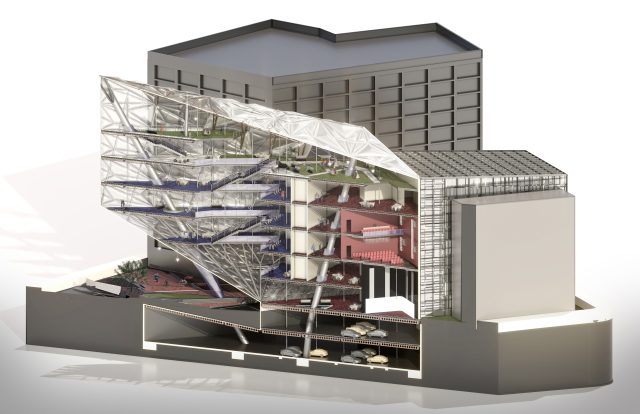 Jonathan Marcos (BArch ’23) and Chelsea Zhao (BArch ’23)