Mauricio Cortés Sierra
“Sagrada Família: The Dream of a Genius,
A Collective Endeavour Across Generations”
Wednesday, October 14, 5:00 p.m. est
Steven Ehrlich ’69 Architecture Lecture
EMPAC Theater
Mauricio Cortés Sierra studied at the National Autonomous University of Mexico (UNAM) in the 1990s. He belongs to a generation marked by the 1985 Mexico City earthquake, which created an atmosphere of obsession with structure, safety, and innovation in the classrooms. At UNAM he developed an interest in structural geometry and lightweight roofs, themes that would later naturally connect with the work of Antoni Gaudí.
After graduating, Cortés moved to Barcelona to pursue a doctorate in architectural design at the Barcelona School of Architecture (ETSAB), the same institution where Gaudí studied in the 19th century. This move would ultimately shape his professional career. In 2006 he began collaborating with the Sagrada Família Construction Board, where he was involved in the development of some of the cathedral’s most complex elements. Cortés is currently the lead architect of the Sagrada Família.
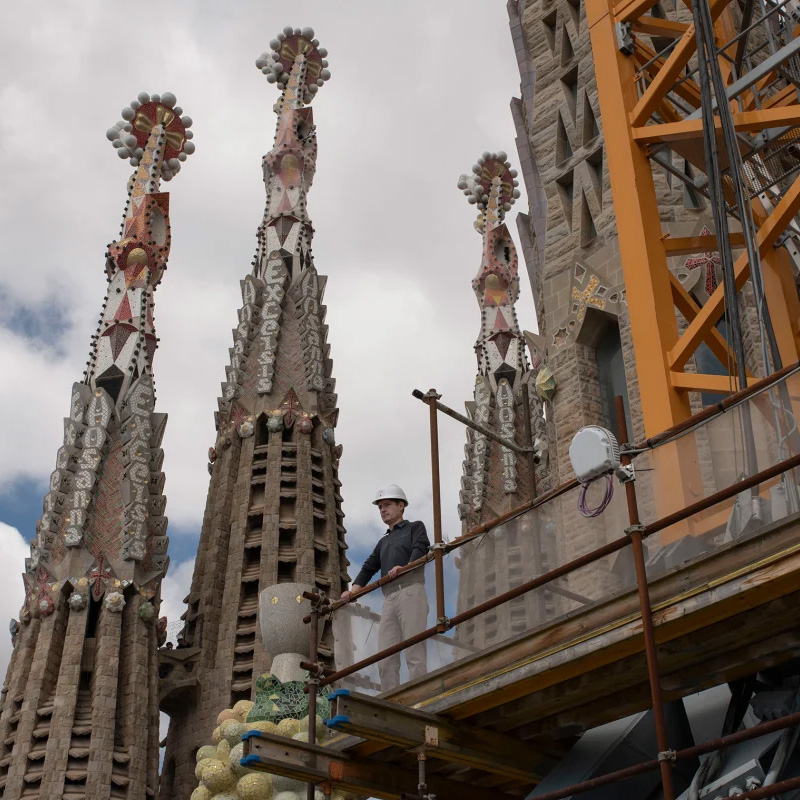
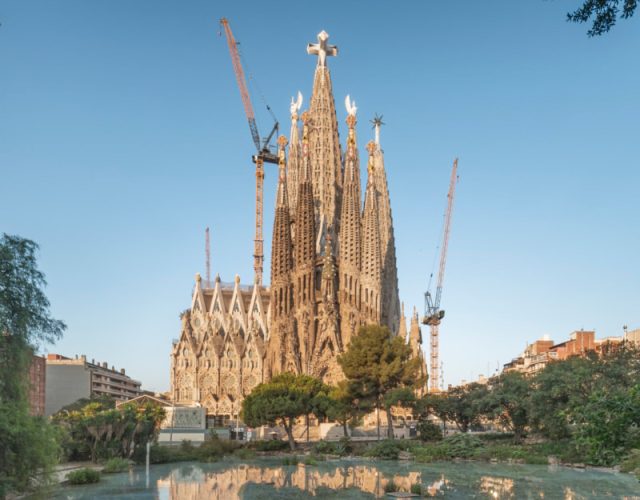
Cortés’ career at Sagrada Família began on its ground floor, where he worked on extending the neo-gothic cloisters around the Nativity facade, the only section Gaudí lived to see completed. These elements feature highly organic shapes with very free forms, in contrast to the more geometrised, parametric spires, such as the Tower of Jesus Christ, which was inaugurated by Pope Leo XIV on the centenary of Gaudí’s death. Completion of the central towers – The Four Towers of the Evangelists, The Tower of the Virgin Mary and the massive centrepiece, The Tower of Jesus Christ – on which Cortés led the design and construction team, was a huge milestone in the cathedral’s construction. Completing the towers was a herculean effort, requiring the adoption of new technologies as well as meticulous studies of drawings, models, written sources and photographs. Cortés lists completion of the cathedral’s main elevation, the Glory Facade, as a primary future challenge for the project.
Working on the Sagrada Família is not like participating in any other architectural project. Its a process that combines history, precision, and an enormous cultural responsibility. Every intervention must respect the structural and aesthetic logic defined by Antoni Gaudí, but also adapt to the technical and construction advancements of the present. It is within this balance between past and future that Cortés’ work unfolds. One of the most complex aspects of the project is that Antoni Gaudí did not leave all the final plans for the basilica. Much of his vision was transmitted through scale models, experimental geometries, and three-dimensional models that are still studied today by architects and engineers. If anything defines the modern era of construction, it is the combination of tradition and technology. The organic forms conceived by Antoni Gaudí are now developed with advanced digital tools, parametric modeling, and high-precision manufacturing processes.
We look forward to seeing you at this lecture.